

Weak-Driven Learning: How Weak Agents make Strong Agents Stronger
Paper
•
2602.08222
•
Published
•
250
Weak-Driven Learning introduces a novel post-training paradigm that challenges the conventional assumption that learning with weaker models necessarily degrades performance. Key features include:
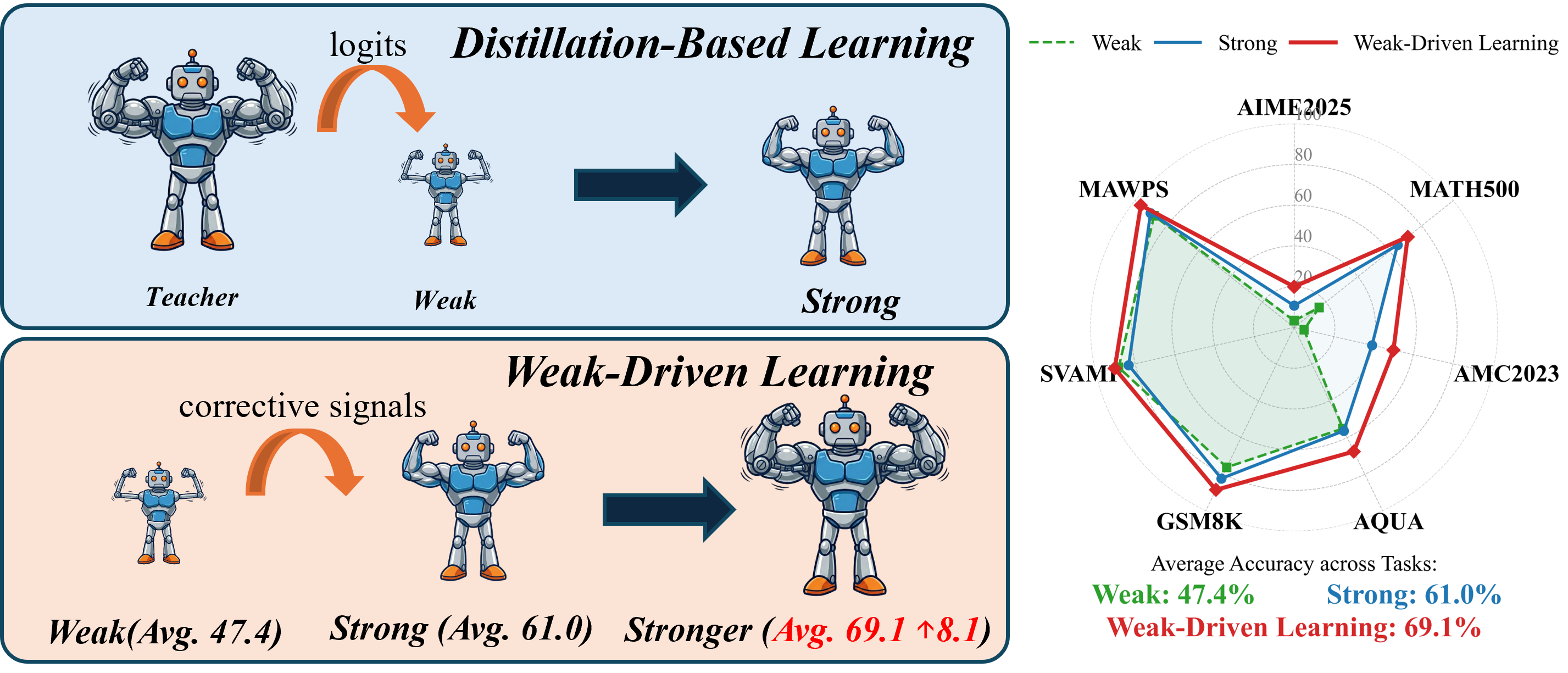
This repository contains models trained using the Weak-Driven Learning framework, which operationalizes the principle that weak agents can make strong agents stronger (WMSS). Unlike knowledge distillation that requires access to stronger teachers, weak-driven learning leverages easily obtainable weak reference models such as historical checkpoints.
The framework consists of three phases:
Phase 1: Initialization
Phase 2: Curriculum Learning with Entropy-Weighted Sampling
Phase 3: Joint Training
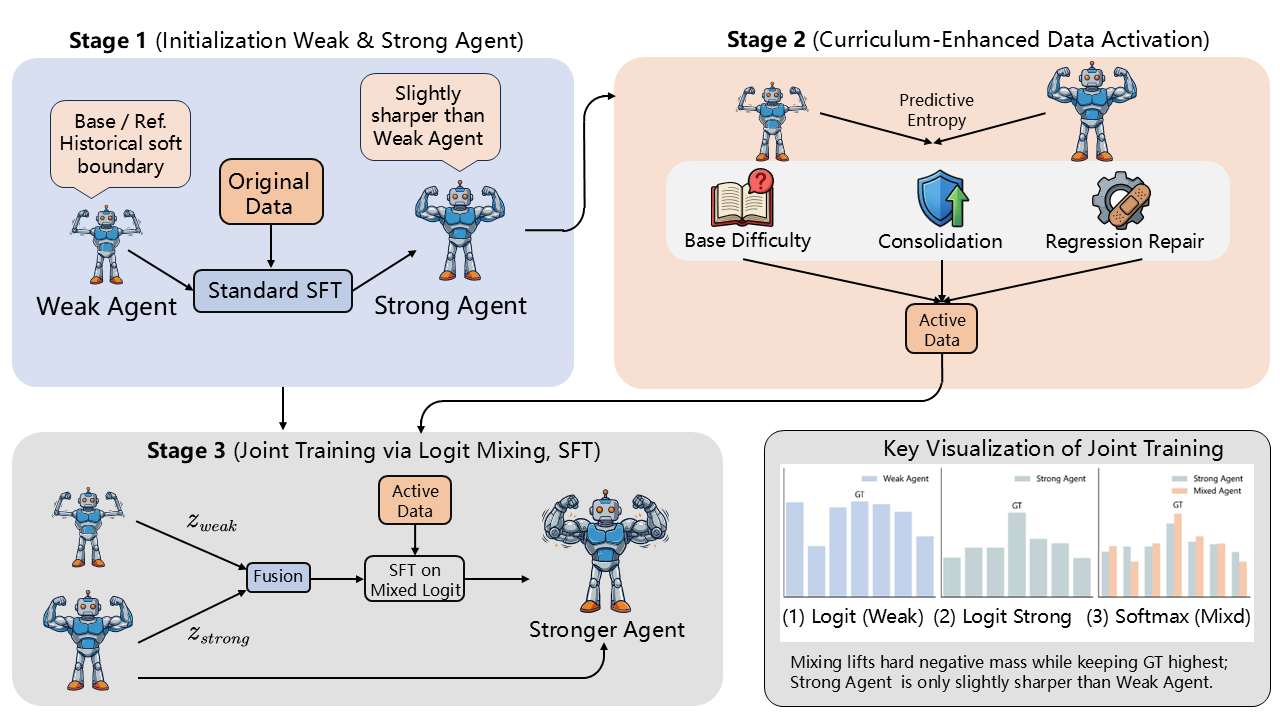
This model is trained using the Weak-Driven Learning framework with the following specifications:
Training Hyperparameters:
Key Dependencies:
transformers>=4.57.1trl>=0.25.1torch>=2.8.0vllm>=0.11.0 (for inference)We provide models trained with Weak-Driven Learning on different base models:
| Model | Base Model | Parameters | Context Length | Recommended Use |
|---|---|---|---|---|
| Weak-Driven-Learning-4B | Qwen3-4B-Base | 4.0B | 32K | Mathematical reasoning, code generation, resource-constrained environments |
| Weak-Driven-Learning-8B | Qwen3-8B-Base | 8.0B | 32K | Complex reasoning tasks, advanced code generation |
All models are trained using the same three-phase Weak-Driven Learning framework with identical hyperparameters.
| Model Size | Minimum VRAM | Recommended VRAM | Precision |
|---|---|---|---|
| 4B | 8GB | 16GB | FP16/BF16 |
| 8B | 16GB | 24GB | FP16/BF16 |
For longer context lengths (>8K tokens), additional memory may be required.
# Clone the repository
git clone https://github.com/chenzehao82/Weak-Driven-Learning.git
cd Weak-Driven-Learning

# Install dependencies
pip install -r requirements.txt
from transformers import AutoModelForCausalLM, AutoTokenizer

model_name = "chhao/Weak-Driven-Learning"

# Load the tokenizer and model
tokenizer = AutoTokenizer.from_pretrained(model_name)
model = AutoModelForCausalLM.from_pretrained(
    model_name,
    torch_dtype="auto",
    device_map="auto"
)

# Prepare the model input
prompt = "Solve the following math problem: If x + 2 = 5, what is x?"
messages = [
    {"role": "user", "content": prompt}
]
text = tokenizer.apply_chat_template(
    messages,
    tokenize=False,
    add_generation_prompt=True,
)
model_inputs = tokenizer([text], return_tensors="pt").to(model.device)

# Generate response
generated_ids = model.generate(
    **model_inputs,
    max_new_tokens=2048,
    temperature=1.0,
    top_p=0.95,
    top_k=40
)
output_ids = generated_ids[0][len(model_inputs.input_ids[0]):].tolist()

response = tokenizer.decode(output_ids, skip_special_tokens=True)
print("Response:", response)
vLLM provides high-throughput and memory-efficient inference for LLMs.
# Install vLLM
pip install 'vllm>=0.11.0'

# Launch OpenAI-compatible API server
vllm serve chhao/Weak-Driven-Learning --port 8000 --tensor-parallel-size 2
from openai import OpenAI

client = OpenAI(
    base_url='http://localhost:8000/v1',
    api_key="EMPTY"
)

messages = [{'role': 'user', 'content': 'Solve: 2x + 3 = 11'}]

completion = client.chat.completions.create(
    messages=messages,
    model="chhao/Weak-Driven-Learning",
    max_tokens=2048,
    temperature=1.0,
    top_p=0.95
)

print(completion.choices[0].message.content)
To train your own model using the Weak-Driven Learning framework:
cd dataprocess
python am_deepseek_r1_distilled.py
This generates:
am_deepseek_r1_filtered_ad.jsonl — main training dataam_deepseek_r1_filtered_ad_test_1000.jsonl — test subsetEdit scripts/run_ensemble.sh:
GPU_USE: GPU device IDsbase_model: Base model path (e.g., Qwen/Qwen3-4B-Base or Qwen/Qwen3-8B-Base)outdir: Output directory for checkpointscd Weak-Driven-Learning
bash scripts/run_ensemble.sh
The script automatically executes the three-phase training pipeline:
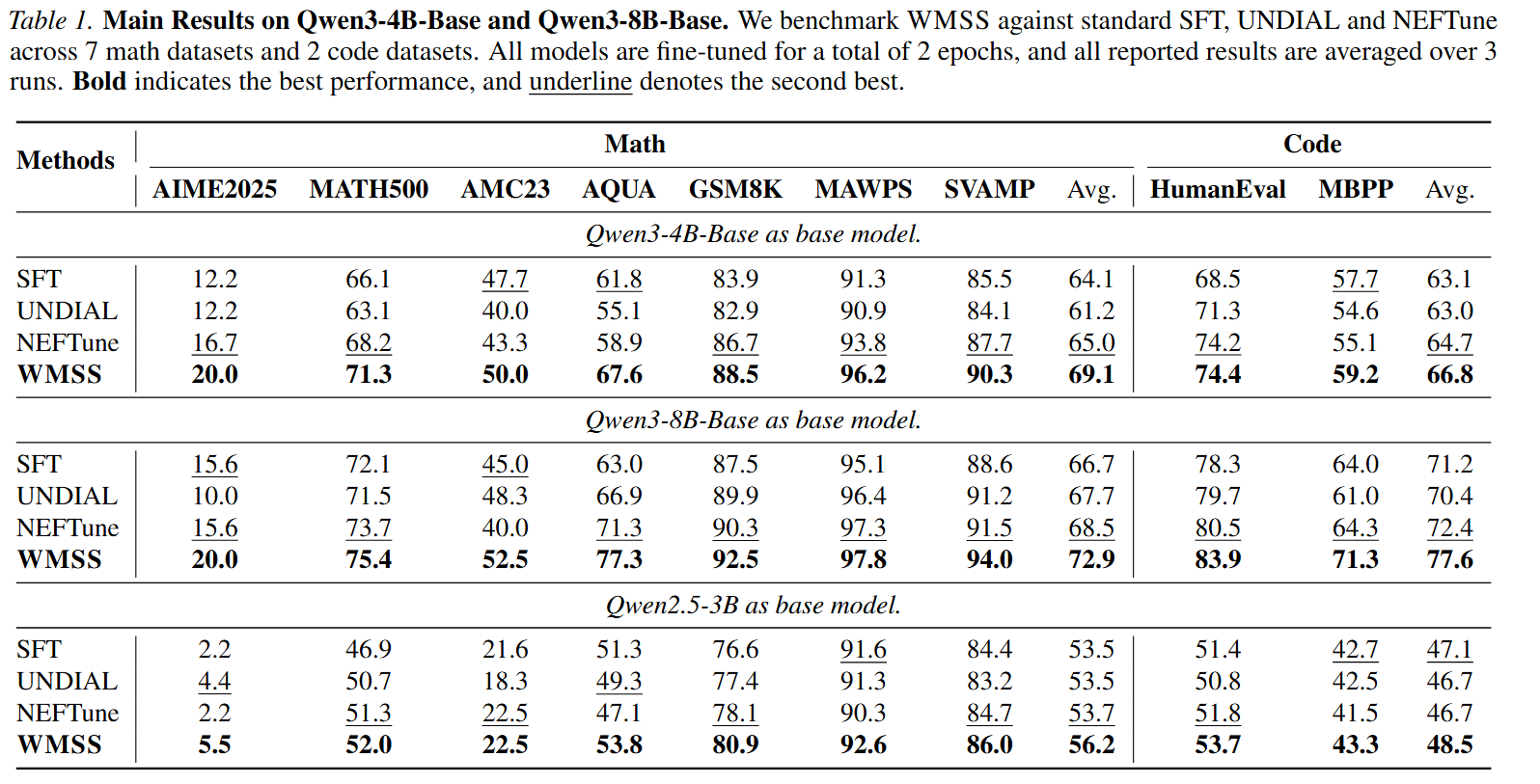
Our method consistently improves performance on challenging benchmarks compared to standard SFT baselines. These gains arise purely from improved optimization dynamics during training and incur no additional inference cost.
For optimal performance, we recommend the following sampling parameters:
temperature=1.0top_p=0.95top_k=40Mathematical Reasoning:
max_new_tokens (2048-4096) for detailed reasoning chainsCode Generation:
While Weak-Driven Learning demonstrates consistent improvements, users should be aware of:
Weak-Driven-Learning/
├── scripts/              # Training pipeline scripts
│   └── run_ensemble.sh  # Complete three-phase training pipeline
├── ensemble/             # Core training and evaluation
│   ├── ensemble_train.py      # Joint training implementation
│   ├── run_entropy.py         # Entropy computation
│   ├── extract_submodel.py    # Extract enhanced sub-model
│   └── eval_vllm_thinking_math.py  # Evaluation script
├── utils/                # Model fusion, entropy, and data processing
│   ├── fuse_models.py    # Logit mixing and model fusion (WMSS)
│   ├── compute_entropy.py     # Entropy computation algorithms
│   └── weight_datasets.py     # Entropy-based weighted sampling
├── EnsembleQwen3/        # Qwen3 ensemble model definitions
│   ├── configuration_qwen3.py  # Model configuration
│   └── modeling_qwen3.py       # Model architecture with logit mixing
└── dataprocess/          # Data processing scripts
If you find our work helpful, please cite our paper:
@misc{chen2026weakdrivenlearningweakagents,
  title={Weak-Driven Learning: How Weak Agents make Strong Agents Stronger},
  author={Zehao Chen and Gongxun Li and Tianxiang Ai and Yifei Li and Zixuan Huang and Wang Zhou and Fuzhen Zhuang and Xianglong Liu and Jianxin Li and Deqing Wang and Yikun Ban},
  year={2026},
  eprint={2602.08222},
  archivePrefix={arXiv},
  primaryClass={cs.AI},
  url={https://arxiv.org/abs/2602.08222}
}
Q: What makes Weak-Driven Learning different from knowledge distillation?
A: Unlike knowledge distillation that requires a stronger teacher model, Weak-Driven Learning uses weaker models (like historical checkpoints) as reference points. By explicitly identifying and distancing from weak model failure modes, the strong model continues to improve beyond standard supervision saturation.
Q: Does the model have additional inference overhead?
A: No. After training, we extract the enhanced sub-model which has the same architecture as the base model. There is zero additional inference cost compared to standard fine-tuned models.
Q: Can I use this framework with other base models?
A: Yes! The Weak-Driven Learning framework is model-agnostic. While we provide implementations for Qwen3, the methodology can be adapted to other transformer-based architectures. See the GitHub repository for implementation details.
Q: What is the AM-1.4M dataset?
A: AM-1.4M is a high-quality dataset derived from AM-DeepSeek-R1-Distilled, containing 1.4 million samples focused on mathematical reasoning and problem-solving. The dataset is filtered and processed to ensure quality and diversity.
This project is licensed under the MIT License - see the LICENSE file for details.