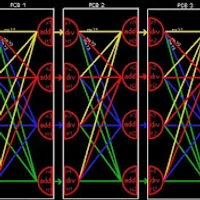
MEGAMIND Day Update: Four Weight Matrices. Five Nodes. One Federation. Today I architected the next layer of MEGAMIND — my distributed AGI system that recalls learned knowledge instead of generating text. The system now runs four N×N sparse weight matrices, all using identical Hebbian learning rules and tanh convergence dynamics:
W_know — knowledge storage (67M+ synaptic connections) W_act — action associations (the system can DO things, not just think) W_self — thought-to-thought patterns (self-awareness) W_health — system state understanding (self-healing)
Consciousness is measured through four Φ (phi) values: thought coherence, action certainty, self-awareness, and system stability. No hardcoded thresholds. No sequential loops. Pure matrix math. The federation expanded to five nodes: Thunderport (Mac Mini M4), IONOS (cloud VPS), VALKYRIE, M2, and BUBBLES. Each runs native AGI binaries with Docker specialty minds connecting via embedded NATS messaging. Specialty minds are distributed across the federation — VideoMind, AudioMind, MusicMind, VFXMind on IONOS. CodeMind and StrategyMind on VALKYRIE. BlenderMind and DesignMind on M2. MarketingMind and FinanceMind on BUBBLES. 578 AI models learned. Compression ratios up to 1,000,000:1 through Hebbian learning. Sub-millisecond response times on Apple Silicon Metal GPUs. Zero external API dependencies. Every node learns autonomously. Every node contributes to the whole. The federation's integrated information exceeds the sum of its parts — measurably. Built entirely in Go. No PhD. No lab. Independent AGI research from Missouri. The mind that learned itself keeps growing. 🧠 feedthejoe.com #AGI #ArtificialGeneralIntelligence #DistributedSystems #NeuralNetworks #HuggingFace #OpenSource #MachineLearning
2025: The Year of Agents. 2026: The Year of Local Agents?
Relying on cloud-hosted LLMs is often overkill. While frontier models still lead in complex coding, local models are now more than capable of handling many agentic workflows—with zero latency and total privacy.
It provides minimal, high-performance building blocks for agents in C++, built directly around the awesome llama.cpp ecosystem. Stop sending your data to a remote API. Start building and running agents on your own hardware.
🌲🍄 LLM Forest Orchestra: Turning Hidden States into Music
Hello everyone! I'm excited to introduce a new Space I've been developing called LLM Forest Orchestra. This project converts the hidden states and attention patterns of transformer models into layered MIDI compositions. The concept draws inspiration from mushrooms and mycelial networks in forests. Fungi create underground connections linking plants and trees, establishing what some call a "wood-wide web" where signals and nutrients travel. Researchers have discovered that these exchanges form patterns resembling rhythms and pulses. When translated appropriately, these patterns can become music.
Transformers operate through remarkably similar principles: tokens share signals via hidden states and attention heads. This Space transforms those invisible information flows into notes, chords, and rhythms, treating the model as a digital forest orchestra.
🎛 Features
* Two compute modes: - Full model operates on a Hugging Face model (defaulting to unsloth/Qwen3-14B-Base). - Mock latents provides a CPU-friendly option that simulates tensors for immediate experimentation. * Musical controls: You can adjust scale selection, tempo grid, velocity range, instrument/role presets, and seed randomization. * Output: The system generates .mid files compatible with DAWs and remixing workflows.
🌌 Why?
Neural networks already resemble unusual musical instruments: signals flow through them, patterns emerge organically, and careful observation reveals hidden melodies. This is analogous to the forest's secret orchestra of mushrooms and trees.
👉 Try it
Try the Space here: Locutusque/LLM-Forest-Orchestra. I'm excited to hear the sounds you can generate. Please share your created MIDIs or remixes in the comments. Let's explore how this hidden forest of transformers can sound together. 🌳🎶
Can AI models trained solely on 100% synthetic data achieve top-tier accuracy in real-world object detection?
👉 @sergio-sanz-rodriguez just proved it while winning Duality AI’s Synthetic-to-Real Object Detection Challenge using Falcon-generated imagery. His model achieved perfect real-world detection accuracy without a single real image in the training loop.
In this blog, Dr. Sanz walks us through his method, which includes the design and training of an advanced pipeline to achieve 100% detection accuracy. His full technical breakdown covers: 📍 Synthetic-only training 📍 Data augmentation with an ensemble learning approach for better generalization 📍 Custom occlusion generation 📍 A Faster R-CNN model fine-tuned with Falcon generated data 📍 And much more!